MPowerUP Token Economy — MPWR
Validation status: [HYPOTHESIS] — This document specifies intended mechanics, not validated ones. Core claims about MPWR increasing mutual aid participation and providing meaningful financial empowerment are untested theories. Legal/regulatory framework requires attorney review before Phase 3.5 development. See Red Team Analysis for specific challenges.
Candidate replacement under consideration: A time-banking design (Edgar Cahn model) is documented as a structural alternative to per-act tokenization, motivated by the Red Team Challenge 1 / Finding 1 evidence on motivation crowding-out. See MPWR Alternative — Time Banking Model in the mpowerup project, also published on the BNI site under Sub-Project Docs → MPowerUP → Research. A companion synthesis — Circle Governance and Milestone Economy — proposes Kay Pranis's peacemaking-circle process and a distributed-donor milestone economy on top of the time-banking layer.
The choice between the per-act design (this doc) and the time-banking / circle-governance direction should be made before Phase 3.5 development begins — they are not compatible, and choosing one closes the other.
Phase 3.5 gate: This specification cannot be implemented until the prerequisite chain is complete. See the MPowerUP roadmap for the full dependency chain.
Known Unknowns
Things this document does not yet resolve. Required decisions before Phase 3.5 development begins.
| Question | Why it matters |
|---|---|
| What is the minimum backing pool required to make MPWR meaningful at launch? | Without a minimum, MPWR launches at near-zero USD value, creating token-pricing harm to participants |
| What happens to participant stakes if BNI LLC fails? | Fiduciary obligation; requires a separate legal entity (trust or LLC) before fund exceeds $10K |
| Will Phase A Community Fund deploy to DeFi or hold USDC flat? | DeFi yield carries depeg and smart contract risk; flat USDC is safer for Year 1 |
| How does identity recovery affect MPWR balance in Phase A? | Device loss should not destroy 6 months of earned stake; BNI-managed ledger should allow DID-linked recovery |
| What is the fair market value methodology for 1099-NEC reporting? | IRS requires FMV at time of receipt; BNI needs a documented, defensible method before any redemption |
| Will MPWR redemption integrate with ABLE accounts? | Critical mitigation path for SSI recipients; requires design decision before launch |
| DECISION REQUIRED: $84/month hard redemption cap | SSA behavioral evidence (30–40% of SSDI recipients modulate work to avoid benefit loss) and EITC kink-point clustering establish that disclosure is insufficient. MPWR token income is episodic and variable — harder to manage against the SSI cliff than steady wages. Until WIPA infrastructure is operational, Phase A must enforce a hard technical cap of $84/month on liquid redemptions. This is not a warning label. It is harm prevention. No pilot, however small, should proceed without it. |
Executive Summary
MPowerUP serves people navigating some of life's hardest transitions: recovery, reentry after incarceration, and houselessness. These communities are rich in mutual aid — in showing up for each other — but that generosity rarely translates into financial stability for the people giving it.
MPWR changes that. Every act of care on MPowerUP — responding to a neighbor's food request, facilitating a Circle, inviting someone into community — earns real-backed tokens. Tokens split automatically into three streams: cash available now for immediate needs, a collective Community Fund that grows through DeFi staking, and a personal long-term stake that builds toward a home deposit, a vehicle, or anything a participant needs to move forward.
MPWR is not a reward points program. It is a financial instrument backed by real revenue — 10% of BNI LLC profit and subscriptions — designed to turn mutual aid into lasting economic opportunity for the people doing the work.
Token Overview
| Parameter | Value |
|---|---|
| Name | MPWR |
| Backing | 10% of BNI LLC revenue + sponsor contributions → MPWR Backing Pool |
| Valuation | Backing Pool ÷ circulating MPWR supply = MPWR/USD rate |
| Rate governance | BNI quarterly review (Phase A); published on-chain (Phase B) |
| Transferability | Non-transferable in Phase A; self-custody in Phase B |
| Ledger | BNI-managed centralized ledger (Phase A); ERC-20 smart contract (Phase B) |
Token Split — Per MPWR Earned
Every token earned by a participant automatically splits into three sub-balances:
████████████████████████░░░░░░░░░░░░░░░░  50% → Liquid Wallet (redeem now)
████████████░░░░░░░░░░░░░░░░░░░░░░░░░░░░  30% → MPowerUP Community Fund
████████░░░░░░░░░░░░░░░░░░░░░░░░░░░░░░░░  20% → Individual Long-Term Stake
Earning Actions
Participants earn MPWR by taking meaningful actions inside MPowerUP. Actions are signed with the participant's did:key identity and recorded on the MPWR ledger.
| Action | MPWR | Rationale |
|---|---|---|
| Create a help request | 1 | Vulnerability and transparency in naming a need |
| Respond to a help request | 3 | Direct act of mutual aid |
| Request resolved — asker | 2 | Completing the loop of care |
| Request resolved — responder | 2 | Recognising the helper |
| Join a Circle | 0.5 | Choosing community |
| Invite someone to a Circle | 1 | Growing the network of care |
| Facilitate a Circle (monthly) | 5 | Leadership and ongoing stewardship |
| Weekly check-in streak | 1 | Sustained presence and engagement |
Anti-gaming: Actions are signed and timestamped. Duplicate or self-referential actions are rejected by the ledger. Rate limits apply per participant per day.
Three-Way Token Flow
1. Liquid Wallet — 50%
The liquid portion is available immediately for USD redemption. Participants can redeem any time their balance reaches the minimum threshold.
- Minimum redemption: $5 USD equivalent
- Phase A channels: Prepaid debit card (instant), ACH bank transfer (2 business days)
- Phase B channels: On-chain USDC to self-custody wallet
- Use cases: Groceries, bus pass, rideshare, rent contribution, clothing, prescriptions, anything
2. MPowerUP Community Fund — 30%
Every participant's 30% flows into a single collective fund. The fund is deployed to DeFi staking protocols in USDC, generating yield for the entire community.
Yield distribution:
Gross Yield
    ├── Gas fees paid (protocol interaction costs)
    └── Net Yield
            ├── 60% reinvested → Fund grows → MPWR backing value increases
            └── 40% distributed pro-rata → individual long-term stakes
- Phase A governance: BNI LLC manages the fund; quarterly public transparency report
- Phase B governance: Community governance — 1 MPWR = 1 vote; on-chain audit trail
- Protocols (Phase B): Aave, Compound, or Lido equivalents; audited + insured
3. Individual Long-Term Stake — 20%
The stake is a personal account that grows in two ways: from the 20% allocation of every token earned, and from the participant's share of Community Fund yield distributions.
- Vesting period: 6 months minimum (prevents premature extraction before value builds)
- After vesting: Participant redeems stake for real USD
- Custody: BNI LLC custodian in Phase A; self-custody wallet in Phase B
- Use cases: First/last month's rent, vehicle down payment, security deposit, education enrollment, medical procedure — anything that moves life forward
User Journey
Persona: Jordan
Jordan is 34, recently released after 4 years, staying in a shelter. A case worker shares an MPowerUP invite link. Jordan scans it, joins a Circle, and sees a neighbour's food request.
Day 1    Jordan joins the Circle
         → earns 0.5 MPWR
         → splits: 0.25 liquid / 0.15 fund / 0.10 stake

Day 1    Jordan responds to a food request
         → earns 3 MPWR
         → splits: 1.50 liquid / 0.90 fund / 0.60 stake

Day 3    Request is resolved
         → Jordan earns 2 MPWR (responder reward)
         → splits: 1.00 liquid / 0.60 fund / 0.40 stake

Week 1   Liquid balance: ~$2.75 equivalent
         Jordan redeems for a bus pass — first dollars earned through community

Month 3  Stake balance: ~$18 equivalent + small fund yield
         Jordan keeps earning, stake keeps growing

Month 6  Stake vests
         Jordan redeems stake: ~$120 equivalent
         → paid toward first month's rent deposit
Flow Diagram
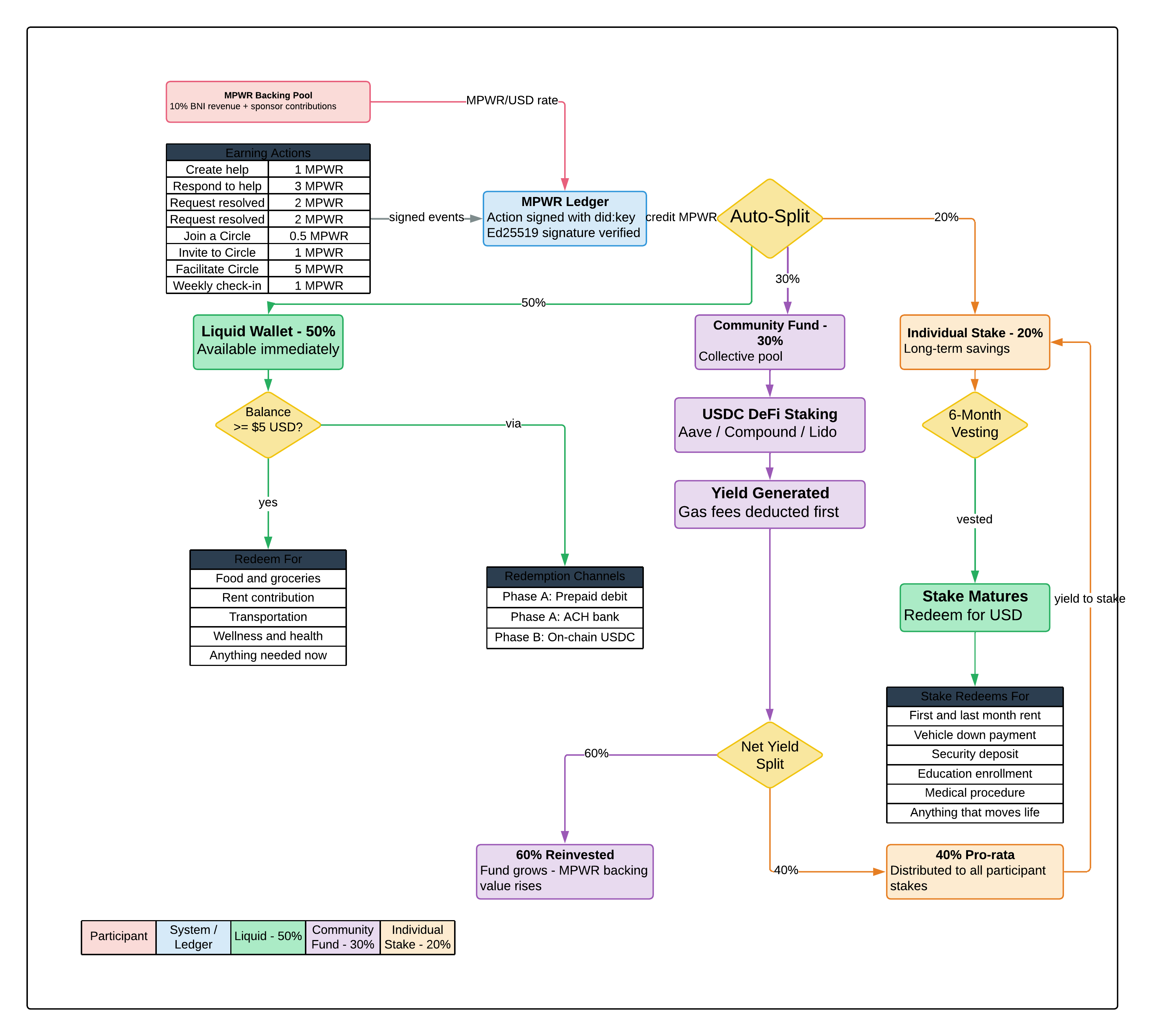
Diagram detail (mermaid)
flowchart TD
    A([Participant takes action\nin MPowerUP]) --> B[Action signed with\ndid:key identity]
    B --> C[MPWR ledger credits tokens]
    C --> D{Auto-split}

    D -->|50%| E[💵 Liquid Wallet]
    D -->|30%| F[🏦 Community Fund]
    D -->|20%| G[🌱 Individual Stake]

    E --> H{Redeem when ready\nmin. $5 USD}
    H --> I[🛒 Food & groceries]
    H --> J[🏠 Rent contribution]
    H --> K[🚌 Transportation]
    H --> L[💊 Wellness & health]

    F --> M[USDC DeFi staking\nAave / Compound / Lido]
    M --> N[Yield generated]
    N --> O[⛽ Gas fees paid]
    N --> P{Net yield split}
    P -->|60%| Q[Reinvested → Fund grows\nMPWR backing value ↑]
    P -->|40%| R[Pro-rata distribution\nto all stakes]
    R --> G

    G --> S{6-month\nvesting window}
    S --> T([Stake matures])
    T --> U[🏠 Home deposit]
    T --> V[🚗 Vehicle]
    T --> W[🎓 Education]
    T --> X[🌟 Anything needed]
Financial Architecture
Phase A — BNI-Managed Ledger
A new backend service (mpwr-ledger) manages all token accounting.
API surface:
| Endpoint | Method | Purpose |
|---|---|---|
/actions |
POST | Record signed action event, credit MPWR |
/wallet/:userId |
GET | Return liquid, fund, and stake balances |
/redeem |
POST | Initiate USD redemption from liquid pool |
/rate |
GET | Current MPWR/USD exchange rate |
/stake/:userId |
GET | Stake balance, vesting status, yield history |
Action verification:
MPowerUP signs each action event with the participant's Ed25519 private key (did:key). The ledger verifies the signature against the participant's public DID before crediting tokens. This prevents forgery without requiring a server-side trust relationship.
Backing Pool funding: BNI reconciles 10% of monthly revenue → wire to Backing Pool → ledger updates MPWR/USD rate. Sponsors contribute directly to the pool with public attribution.
Phase B — On-Chain Migration
Aligns with MPowerUP Phase 4 (Helia IPFS, OrbitDB, W3C Verifiable Credentials).
- MPWR token: ERC-20 (Ethereum) or SPL (Solana), backed by USDC reserve
- Community Fund: Smart contract — transparent, auditable, community-governed
- Individual stakes: Held in participant's self-custody wallet via Verifiable Credentials
- Action proofs: Stored on Helia IPFS; on-chain oracle verifies before minting
Integration Points in MPowerUP
Phase 3.5 — none of these exist yet. These are planned changes to the MPowerUP codebase.
| File | Planned change |
|---|---|
src/services/helpRequests.ts |
Add onRequestResolved() hook → emit signed action event to mpwr-ledger |
src/services/messages.ts |
Hook facilitate/respond actions → emit signed events |
src/db/schema.ts |
Add token_events table for local optimistic record |
app/(tabs)/wallet.tsx |
New wallet screen: balance, 50/30/20 split view, redeem button |
Regulatory & Compliance
These are identified risks requiring legal counsel before Phase A+ goes live. BNI must not proceed to live redemptions without addressing each item.
| Risk | Detail | Action Required |
|---|---|---|
| Securities law | MPWR must not be structured as a security. Non-transferable in Phase A is protective. No secondary market without attorney sign-off. | Securities attorney review before Phase B |
| Money transmission | Redeeming tokens for USD may require MSB (Money Services Business) registration in operating states. | Fintech legal counsel; state-by-state MSB analysis |
| KYC / AML | Redemptions above $600/year trigger IRS 1099 reporting requirements. | Identity verification at redemption threshold; 1099 issuance process |
| Fiduciary duty | Community Fund custodianship creates fiduciary obligations for BNI LLC. | Establish a separate fund entity (LLC or trust) before fund exceeds $10K |
| Benefits impact | USD redemptions may affect SSI, SNAP, Medicaid, or housing assistance eligibility. This is critical for the target community. | Partner with a benefits counseling org; add in-app benefits impact warning |
| DeFi protocol risk | Smart contract exploits could drain the Community Fund. | Protocol audit + on-chain insurance (e.g., Nexus Mutual) before Phase B |
Phased Rollout
| Phase | Deliverable | Timing |
|---|---|---|
| Phase A | This spec + ledger design + MPowerUP wallet UI mockups | Now |
| Phase A+ | mpwr-ledger microservice + MPowerUP action hooks + wallet screen |
MPowerUP Phase 3.5 |
| Phase A++ | Live redemptions via prepaid debit + Community Fund (BNI-simulated returns) | Post MPowerUP launch |
| Phase B | On-chain MPWR + smart contract Community Fund + self-custody stakes | MPowerUP Phase 4 |
Research & Feasibility
A full research document covers the three foundational questions before building:
- Is MPWR legally permitted? Yes — with FinCEN MSB registration, securities attorney review, state MTL or BaaS partnership, and benefits counseling for participants. Details: MPWR Research & Feasibility
- Is it technically feasible? Yes — centralized ledger (Medici/Blnk), ERC-20 + ERC-4626 (OpenZeppelin), WalletConnect/Privy on Expo, USDC yields 3–8% on Morpho/Aave. Details: Technical Feasibility
- Can a third-party custodian be used? Yes — strongly recommended. Stripe Issuing + Sila + Circle covers the full stack. Do not use Synapse (bankrupt 2024). Details: Custodian Options
Why This Matters
The people MPowerUP serves are often excluded from the financial system — no credit history, no savings, no safety net. MPWR doesn't ask them to be consumers of a financial product. It asks them to keep doing what they already do: show up for each other. The token economy is built around that reality.
A bus pass this week. Rent next season. A home deposit in a year. That is the arc MPWR is designed to support.